The
Edinburgh Geologist
Issue
no 38

| |
|
| ||||||||
|
|
|
|
|
|
|
|
|
| ||
|
The
Edinburgh Geologist | | ||||||||
translated
by Radvan Horny If a spectacular comet appears on the horizon, then the whole population is transfixed by the force of Nature and delights in seeing the phenomenon before it disappears. If a man whose glory echoes all over the educated world should visit our country, then all who recognise the worth of that learned man, delight in revering one who has devoted his life to science. The
arrival of the British geologist Murchison in Bohemia last August should be taken
as such an event, and I should like to let readers know some of the details of
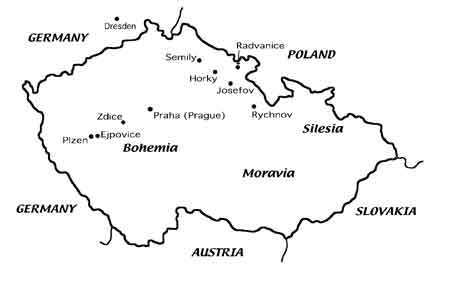
his stay in our country, as well as something of his character. Click
here to see map Stopping at the village of Ejpovice, we saw the Cilina Hill on the southern side, built of impressive beds of the Drabov quartzites. The valley below us led off to the north through a depression between the Komarov and Rokycany beds, where iron mines run into the ground in all directions. A short time before, railway cuttings had exposed the beds and made it easier to interpret the structure. It really is a source of great pleasure being a geologist, one to whom every stone whispers words of everlasting Truth, one who sees irreversible Laws of Nature occurring over all the parts of the Earth. And how the attraction of a geological excursion increases when in the company of a man who, as an apostle of Science, was the first to pronounce these Laws and now follows their truth in various countries. Murchison was the first to distinguish the Silurian system
as the oldest division of beds characterised by fossils, and named it after that
part of the British landscape, once inhabited by the ancient Silurs people, where
this system is beautifully developed. A few years ago I travelled in this area
with the well-known palaeontologist Salter, and I was therefore able to explain
to Murchison the setting of our Silurian by means of correlation of our beds with
those in Britain, which is, according to the present knowledge, in the table:
After being cared for that evening by the Czech family of Mr Antonin Jelinek, an owner of a spinning mill in a town of Lochovice, the next day Murchison studied the landscape around the town Zdice, where shales and quartzites of the lower Silurian system border with basaltoids, supporting the Lower Silurian limestone basin. Murchison had already visited the region between Beroun and Prague in 1848 and therefore went by railway directly to Prague. He said candidly that he did not want to visit the enigmatic sites of the so-called Colonies, because he had not enough time spend there, and neither did he want to take a part in a dispute that concerned his old friend Barrande. Staying for two days in Prague, he visited Barrande again and examined the beautiful fossil collection of the Abbot Zeidler, being enormously surprised by the splendour and beauty of the specimens. He examined the collections in the Czech Museum very thoroughly, and discussed for a long time with Professor Krejci the relationship between the gneiss and the so-called Archaic shales in Bohemia which he, in analogy with northern Scotland, considers not to be Archaic but metamorphosed lowermost beds of the Silurian age. Visiting the Patriotic Society, he conversed for quite a long time with professors Purkyne, Palacky, and Rieger, and had the benefit of a visit by Mr Vojta Naprstek, being informed that he was the only man in Prague who subscribed to the world journal ìThe Timesî and was zealously interested in English and American literature. On September
4th I again attended our distinguished guest on his way via Josefov to Ratiborice,
from where we intended to make an excursion to a fossilized forest near the village
of Radvanice. Murchison had letters of recommendation to Duke Lippe who, unfortunately,
was away. We were received so unkindly by a deputy officer (an alien) that I blushed
for shame and, being unable to get any hay for our weary horses, we had to return
disappointed all the way to Josefov on the same day. He was troubled at the present time by the over-learned Germans who wanted to re-christen the old and honourable name of the Permian to the Dyas, and feared that his exhausting work in the Permian region would be forgotten. On the same day we arrived at Semily and followed the beds in a railway cutting, as recorded in the excellent maps of the Imperial Survey. On September 6th we went from Semily to Libstat, where Mr Maryska, a parish priest and a keen collector of natural objects, was our guide for the whole day. Here we saw an excellent fish locality in black shales near Kostalov and coarse-grained conglomerates with malachite sandstone in a railway cutting. Quickly
flying by railway through the Cretaceous system near Turnov and the Archaic slates
at Zelezny Brod, we made the last excursion on the next day near Rychnov, where
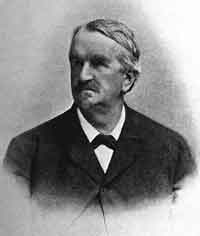
again Archaic slates, limestones, and porphyries occur. A week after Murchison's departure, that well-known secret circular was sent out, in which the political officers were instructed to watch both of us travellers, to ensure that we were not engaged in political canvassing. As far as I myself was concerned, this matter did not surprise me, as our family had for many years had the pleasure of special attentiveness in this regard. The fact that even our celebrated guest, according to the style of the circular, was suspected, has been deplored by public opinion in domestic and foreign journals. A study of Murchison's biography best confirms how unsubstantiated were the apprehensions of the authorities. Sir Roderick Impey Murchison was born on 19th February 1792 in Taradale, Ross-shire in Scotland. He received the first part of his education in the so-called Grammar School, and at 13 he entered the military school at Marlow. There he stayed till 1807, when he entered the 36th Infantry regiment. During this time, he stayed briefly at the University of Edinburgh, and in the Spring 1808 he sailed to Portugal with the Wellesley expedition and fought in the battles of Vimiera and Corunna. Later he served with his uncle A. Mackenzie's staff in Sicily, and took a part during the siege of Cadiz. Reaching a rank of captain in the 9th Dragoon regiment, he left the military service and married in 1815. Since that time he enjoyed travelling over Europe and taking part in audacious fox-hunting. In around 1822, his loving wife tried to turn his mind to a less dangerous occupation than hunting foxes from fast horses, and herself began to collect Cretaceous fossils. Soon she succeeded in satisfying her husband of the importance of these relics of ancient times and inspired him to study them. Sir Humphrey Davy, with whom he met by chance when fishing, also influenced him so that he entirely devoted himself to science. Between
1822-24 he attended lectures in the Royal Academy and educated himself in chemistry
with Richard Phillips. Selecting geology as a subject of his research, he soon
became a member of the Geological Society of the Royal Academy. Between 1828 and 1830 he studied with Professor Sedgwick the eastern part of the Alps. Coming back to England, he began to study systematically the ancient rocks of Wales and, after seven years of unstinting effort he produced an extensive work The Silurian System in 1838. This work deals mainly with the rocks that were deposited as the first containing remains of animal life. He divided them into upper and lower. Anxious to find this system also on the European continent, he realised more journeys to the Rhineland, and in 1840 he travelled, together with the French scientist Verneuil, over north and central Russia. In the same year, the Czar Nicholas bade them explore his Empire from a geological point of view and they spent two years on this mission. Passing over the Urals eight times and thoroughly examining the southern territory of Russia, Murchison alone then visited the Tatra Mountains of Poland as well as Sweden, and in 1845 published, together with Verneuil and Count Keyserling, a large work in French about the geology of the European Russia and the Urals. For this work, Murchison was appointed a Knight of St. Anne and received a large cross of St. Stanislas from the Czar. Coming back to his homeland, he was made Knight by the Queen of England, and after publishing the book about Russia in English, he received the Copley Medal from the Royal Society in London. In 1854 he published the work 'Siluria' in which he described the Silurian as a separate System, present in many parts of the old and new worlds, with an attached review of the world distribution of gold. His thorough work on the deposition of gold in the Urals contributed greatly to the discovery of gold in Australia. Murchison, analysing the rocks sent to him from Australia, recognised that gold should occur there, deposited in similar conditions to those in the Urals, and it was eventually discovered just as he said. For several years, Murchison was the Director of the Institute of Practical Geology and President of the Geographical Society in London. He has an appearance of English aristocrat, and his upright posture and firm step, in spite of his substantial age of 71, show that he was a soldier when young. Tireless in his research from the early morning till late at night, he fervidly loves beautiful rocks, fossils, and Nature in general. He is very thorough in observation, and has a great interest in historic sites, in folk customs and in Nature, diligently writing everything memorable in his diary. His avowal that he will
try to spend a future summer holiday in Bohemia demonstrates that he was satisfied
with his stay in this country. Biographical note on Professor Antonin Fric Professor Antonin Fric (1832-1913) is considered by many to be the greatest Czech museologist, pedagogue and educationalist of the nineteenth century. He devoted his life to the Czech Museum (Museum of the Czech Kingdom, now the National Museum). From 1855, he was curator of the zoological collections. In 1864, he founded the Geological-Palaeontological Department and from 1871 was Professor at Prague University. In 1880, he was made Director of the Zoological and Palaeontological departments of the Museum. He travelled widely, including to Great Britain, the Mediterranean and the USA. His main works in zoology were monographs on European birds and Czech bats, fish and crustaceans. In palaeontology, he wrote on the stratigraphy and palaeontology of the Czech Upper Cretaceous, Carboniferous and Permian fauna. he also published several important books about the popularisation of geology and palaeontology.
[Return to Edinburgh Geologist index] | ||||||||||||||||||||||||||
[Home] [News] [About]
[Lectures] [Excursions]
[Publications] [Edinburgh's
geology] [GeoConservation] [Links]
| ||||||||||||||||||||||||||