| Red
herrings by the barrel the
Editor interviews Donald McIntyre
Donald McIntyre
might be called the “Father of the Society” having been a Fellow
for sixty years. I went up to see him in Perth, to chat and carry home a few stories
to share with readers. I soon learnt that he has an amazing propensity for going
off at all sorts of tangents as he talks, though the story always comes around
full circle to the point of it all. He knows this himself and the title of this
article stems from a lecture that he gave to the Royal Society of Edinburgh in
1986 during a celebration of The Enlightenment. After a long and apparent deviation
from the main subject, in which he had read from The Edinburgh Advertiser of 1788
a brief mention of the publication of the first volume of the Transactions of
the Royal Society of Edinburgh, he found another announcement: “Red Herrings
- a parcel of fine red herrings, to be sold in barrels, at James McIntyre’s,
New Quay, Leith.” Laughter rocked the auditorium! Read on and see what I
mean...
Ed: Donald,
the Society records show that you are the longest-serving Fellow of the Society.
I thought that readers of The Edinburgh Geologist might be interested in hearing
something about you and your life and the people that have influenced you especially
at the start of your career. Donald: My
father's father came originally from Balquhidder but he moved to Edinburgh and
worked for the paper-making business of Bertrams of the Sciennes. My grandfather
on my mother's side was a doctor in Morningside and went on his rounds in a horse
and carriage. When he got a car, and it must have been one of the first in Edinburgh,
the groom who looked after the horses became the chauffeur. When he washed the
car he spoke to it as he had to the horses! I mention these things to show how
much has changed - these were before my time but not much before my time.
My father, at the beginning of the [First World] War,
joined up in the Horse Artillery. There are pictures of him with the horses; they
actually went into battle with horses in France. And then he was shipped to the
Mediterranean. They were in port for a long time in Alexandria and the officers
(he was then a sergeant in the RA) got fed up and went to town- you can just imagine
the situation. What happened was the ship sailed without the officers. They were
sailing to Galipoli, so these officers had essentially deserted in the face of
the enemy. They could have been shot; it wasn't a question of a reprimand, it
was something more serious than that. So he was the senior person in the group
and he was actually commissioned in the field in Galipoli. After the war he decided
to become a minister so he took his degree in Edinburgh and his first charge was
in Callander. We later came to Edinburgh to Morningside High Church, which is
now the Churchill Theatre. So when did you
first develop an interest in geology? When
war broke out we were on holiday in Rothiemurchus. We always went to the Highlands
and I was accustomed to climbing hills. My brother and I were at Watsons but my
father decided that it would be unwise for us to go back to Edinburgh so we moved
into digs in Grantown-on-Spey. That was a fantastic experience! I was in the Cairngorms
virtually every weekend, so I knew those hills well. One of my friends was evacuated
to Grantown to be billetted as an evacuee. His host had been a teacher and I got
to know him. He was very interesting. He knew about the Gaelic place names of
the hills and he told me about- I'll call it geology but he didn't use that word.
He gave me the memoir of the explanation of the sheet
that covered that western part of the Cairngorms- Mid Strathspey and Strathdearn.
Hinxman was one of the main authors of the sheet. As you can imagine, two thirds
of it concerned itself with the 2V of the amphiboles, which meant nothing to me
but, and this is the very important thing, about a third of the memoir was on
the glaciation. And by golly, that was well done! I could see the ice coming down
the Spey. Near Kincraig, there are two streams that come down from the Monadliath
and turn at right angles to run almost horizontally for a while before turning
to run down once again. This was at the height of the ice- and so you know I could
see the ice level. And there are numerous ridges coming out of the Cairngorms
with V-shaped notches in them. This was because the ice coming down the Spey went
up into Glen More and pushed up into glens such as Glen Einich and the Lairig
Ghru, so instead of the ice coming down as you would expect, the ice was pushing
up and there were corrie glaciers higher up. The water drained right round Glenmore
and when it came to one of these ridges, it cut a V-shaped notch. And I could
see these V-shaped notches- I knew them well! And of course there were the great
gravel deposits at the mouths of Glen Einich and the Lairig Ghru with crescentic
moraines that were crescenting the wrong way. It was absolutely fantastic to me.
It really turned me on. And did that encourage
you to study geology? Well, at that time
and for a while, a long while afterwards, geology was a three-year degree- you
did mathematics, physics and chemistry first. So when I went to Edinburgh University,
I was enrolled as a chemistry student and that meant that classes were predetermined.
There was no question for example of taking a class on philosophy of science or
the history of science- ridiculous- but that was the way it was. Now, in our mathematics
class- you know, in those days one of the great things was that the professor
taught the elementary class in every subject. That's a marvellous tradition and
ought to be kept up in every Scottish university. Well, Sir Edmund Whittaker was
the professor of mathematics and he was famous as a cosmologist as well as being
a pure mathematician. The mathematics department at that time was in Chambers
Street and we sat there at benches. I was beside a man (we always happened to
sit in the same place; I don't know whether that was de rigueur but that's what
happened) and this was Sandy Renwick. Later on, he became Director General of
the International Geological Congress. He'd been educated in the south of England.
Anyway, he was there and he had yellow gloves and a cane and wore a monocle. He
must have been the last of the Great Colonials, absolutely the last, probably
fifty years later than anyone else. Anyway, Sandy Renwick hadn't risen to these
heights when I knew him in the maths class. He
told me that he intended to do geology. "Geology," I said, "what's
geology?" He told me something about it because he'd done geology at school
and I thought 'this is interesting'. Now, the Director of Studies was Robert Campbell,
Reader in Petrology and acting head of the geology department when I first took
a class ? Professor Jehu was ill. So I'd seen Robert Campbell before signing up
for mathematics, physics and chemistry in my first year. When I went back to register
for the next year, I asked him about geology and he was delighted and (it wasn't
very difficult) talked me into taking geology. So
your move to geology was mainly because of your love for the Cairngorms?
Oh absolutely! That's right- and I knew that other hills
were not the same as the Cairngorms. So then I was a student in Edinburgh, a second-year
student taking chemistry and geology. I had the beginning class from Robert Campbell
in my first term and in my second term from Dr. Finlay who was the palaeontologist
and Alec Cockburn. The staff consisted of the Professor, which when I went there
at first was Thomas J. Jehu, and Robert Campbell, Reader in Petrology, and R.M.
Craig, who taught Economic Geology, and T.M. Finlay, who taught Palaeontology,
and Cockburn who was the Assistant- when he did his PhD on the geology of St Kilda,
he lived there with the St Kildans. He told me a lot about that. And another interesting
fact is that his son was called Ewen. He was named for the Ewen who was
the St Kildan with whom Dr. Cockburn lived when he did his PhD- that was an interesting
connection. Our son is called Ewen and the only Ewen I knew before was a boy who
was named for a St Kildan. Cockburn taught nearly
every subject. He would do the diagrams and all that kind of thing- now that's
an interesting thing- you know, there was no photocopying of any sort at all,
no Gestätners and everything had to be written in chalk on the board. That
was the way that Cockburn taught in the geology department in my time. He would
spend hours on the blackboard putting in coloured diagrams of cross-sections of
the Moine Thrust. Hours- then after the class, a lab boy would come in with a
bucket of water and a cloth and wash the whole thing off. In
my third year, that was 1943, Arthur Holmes took the chair of geology. That made
a big difference to the Department. I was in his class for Advanced Physical Geology
and in his introductory lecture to that class, there were three students. I was
one- One of the famous Norwegian geologists, the top Norwegian geologist of that
time was Holtedahl and his son was at sea when the Germans invaded Norway, so
he didn't go back. He came to Scotland and was in uniform when he came to Holmes's
lectures. The third person wasn't a geology student. He eventually became the
Secretary of the Communist Party of British Guyana. Anyway, the three of
us sat there and Holmes gave the most lucid lectures from notes which he had in
front of him, mainly of course from the draft of his Principles of Physical Geology.
I kept very careful notes from Arthur Holmes's lectures (I later gave them to
the special collections at Edinburgh University). I did that for only one other
lecturer and that was Professor Kendall of Chemistry, and it's an indication of
the way that he lectured and the way in which I responded to his lectures.
You know, the staff had all been there for so long- two
had been students there. Campbell had been a assistant to Geikie and went fishing
with Benjamin Peach. He would tell me stories about Peach in the field- from being
a contemporary really- Campbell smoked a pipe- it was a straight pipe which hang
from his teeth. The only instruments we had were petrographic microscopes ? great
glass bell jars over them ? and Dr. Campbell would come in and go to show me something
under the microscope. He'd take the big glass bell jar off and he'd be talking
while he was doing it, which he could do holding a pipe in his teeth. He'd be
looking at me as he was doing it and then he'd say, "what a mess on this
microscope, what have people been doing here?" but all the time it was the
ash from his pipe. Of course he was fantastic in old style Rosenbuschian petrology-
absolutely fantastic. Well, that might give you something of a flavour of what
it was like. My teachers talked to me ? some of the classes were one on one ?
about people like Hutton. If Hutton had arrived I wouldn't have been surprised!
Then you joined the staff there when you graduated?
Arthur Holmes wanted me to join the staff as petrologist
when Robert Campbell retired but the first vacancy was going to be R.M. Craig,
the Economic Geologist. Dr Finlay was the first to retire. So Holmes turned to
Glasgow which was a palaeontological school. Gordon Craig was the last student
of A.E. Trueman and the first student of T. Neville George. And so he and I were
invited to lunch with the Holmeses... so I was at Gordon Craig's interview. Maybe
I was to be there just to make it easier for him, somebody not as old as his grandfather!
And Gordon can still tell you what we were served. Anyway Gordon then came on
the staff and Holmes had to find something for me to do for a year before R.M.
Craig retired. Now you see, the granite controversy
was at its peak; the discussion waxed very hot on the origin of granites and,
as you can imagine, the reason for that was that we didn't know enough, we couldn't
know enough. The presidential papers by H. H. Read for example, who was the President
of this and the President of that, were on the origin of granite and migmatites.
Well, Holmes wanted me to find out more so he sent me to work with Wegmann, who
had published an important paper on the origin of migmatites in Geologicshe Rundschau.
He sent me to Switzerland, which was a fantastic opportunity. Unfortunately, I
was just too late to know Argand (picture below), who had
just died but Wegmann (picture below) had taken the chair
and he gave me Argand's coat to wear and for my birthday, he gave me a little
box of Swiss cigars, they were the last ones that Argand had, with a little pencil
with Argand's teeth marks on it- they were like holy relics. Argand of course
did some great work on the structure of the Alps and of Asia. In fact he shows
continental drift in his 1926 paper. He shows why the Himalaya are high because
India is going down underneath. Now, Wegmann was
an extremely difficult person. I hadn't been there very long (it would be a matter
of days) before we set off for the field, where he was doing his field work in
the Vallais, the High Alps. There were people in Neuchâtel who were taking
bets as to how long I would last because nobody else had ever lasted with him
because he was so difficult. To give you an idea of what was involved, we went
by train, of course, and Post Bus. When we got into the train, we sat facing one
another beside the window. And I said to him, "Now, Professor Wegmann, I
have tried to read up on your work," because Holmes had told me nothing about
it, you see, "and I know that there's a particular thing that you talk about
as the B-axis. But I haven't been able to figure out exactly what a B-axis is.
I know it's a very crucial part of your work, but can you tell me what a B-axis
is?" He looked at me- 'what kind of moron has Holmes sent me?' He never answered
questions by giving an answer, he asked another question. He always did that and
his question was, "Well, tell me, here's an ash tray. It's fastened here
just below the window. Why is the B-axis of that ash tray parallel to the B-axis
of the train?" Now seeing that I'd asked what the B-axis was, that wasn't
so easy, so I looked at this thing and I could see that it was hinged at the bottom
and that was the only kind of axis that I could see. But the trouble was that
that was parallel to the length of the train while the axles of the train were
at right angles. Now, the question was 'why were they parallel?' so I had obviously
missed something. "Well, Professor Wegmann," I said, "I'm sorry,
I don't understand." He was very annoyed- 'what kind of person have I got
here?' and he answered that with another question, "If the B-axis of the
ash tray weren't parallel to the B-axis of the train, how could you empty the
ash tray without turning the train upside down?" After
I got back, I told this to some of his students and they laughed till they were
sore. But nearly a year later, near the end of my time there, the French Association
for the Advancement of Science met in Geneva and I was asked to give a talk- which
I did in French, which surprises me now, but anyway, I gave a talk at Geneva and
after that there was a field trip through the Jura Mountains. I went with Wegmann
and others on this trip and we ended up going by train through the tunnel from
Besançon to Neuchâtel. Wegmann got me to sit by the window and look
at the geology in the cuttings as we went past while he was talking to his colleagues
who were going further on to Berne and Geneva... they were all talking in Swiss
German and I didn't understand a word that they were saying. And they were getting
more and more heated in controversy- Wegmann was getting quite angry and he was
going on and he finally turned to me and said, "Well, we'll hear what M.
McIntyre has to say on this question." And I thought, 'what on earth is this?'
and he said "Why must the B-axis of that ash tray be parallel to the B-axis
of the train?" And I said, "Oh. Mr Wegmann, that must be a very complicated
question because the first answer that comes to my head seems so simple. It must
be more complicated than that." And he said, "No, come on, tell us!"
and I said, "Well, if the B-axis of the ash tray weren't parallel to the
B-axis of the train, how could you empty the ash tray without turning the train
upside down?" I said this because I knew the answer. Well it turned out that
some of his students were sitting right behind us and they were hearing this whole
thing. They were nearly in hysterics, because they knew that I had no idea why
that should be the answer, but Wegmann said, "That's the sort of tectonics
we teach in Neuchâtel!" Anyway it gives
you an idea of the kind of situation. After that, I came back to Edinburgh and
was taken on in the inappropriate position of Economic Geologist, of which I knew
very little. But what I did worked out quite well: I taught what I knew. For example,
I'd really learned about stereographic projections in Switzerland. Some of my
students were from the Heriot Watt working for a BSc in mining. They had all sorts
of complicated underground mining surveys that they had been given as problems
and I solved these problems very easily with a stereographic projection because,
you know, I was the first to publish a stereographic projection showing a fold
axis determined from the normals to the bedding planes. It was first done in a
paper in 1929 by Wegmann but he was doing it with imaginary data, but I published
in the QJGS the first actual data where a fold axis was determined in that way
in the paper between Grantown and Tomintoul which was published in '51. So I was
able to show these mining students how they could solve their problems quicker
than the teachers could make them up. Anyway,
this was the kind of thing I was doing and teaching. Then in 1951, the British
Association for the Advancement of Science met in Edinburgh. It was a big meeting-
Edinburgh was considered a very important place for a meeting and there hadn't
been one there for many years. Holmes should of course have been the main host
but Holmes was a very shy man, so he and Mrs Holmes left Edinburgh and went to
Donegal for field work while the meeting took place in Edinburgh. I had to take
his place. I arranged a field trip to the Highlands for the distinguished foreign
visitors, Anders Kvale of Norway, H W Fairbairn of M.I.T. and Frank Turner of
Berkeley (picture below). That
field trip was very successful and Turner invited me to go in '52 to Berkeley
and bring some of the marbles from Strathspey with me, because I knew their context
and he wanted to use the information that he and David Griggs had obtained by
experiments; Turner did the microscopic work, on twin lamellae and showed how
the crystals deformed. You see, with quartz but the trouble with quartz, all you
can measure optically is the c-axis, whereas with calcite you've got planes of
cleavage, planes of lamellae, twin lamellae in three dimensions ? and of course
it's easier to deform calcite than quartz. Turner and Eleanor Bliss Knopf had
published a series of important papers in the Bulletin of the Geological Society
of America on the experimental deformation of marble. So I went to Berkeley for
the summer of 1952. Well, immediately I met some fascinating people there because
Berkeley was one of the great geological institutes of the world at that time,
the people that were there were an absolutely fantastic group- I am tempted to
tell you more about them but perhaps it's beside the point! Although it influenced
me, of course, about the possibility of going there permanently because of that
environment- that was very important too but we'll leave that aside as well.
I hadn't been in Berkeley very long before Turner left
for the International Geological Congress in Algiers. But before he went, he gave
a wine-tasting in my honour at Berkeley. He knew all the people that mattered
in Berkeley and at Stanford, and Californian wine was just taking off. Let me
backtrack. When I was in Switzerland I was indoctrinated to the art of wine tasting
because Argand had been a professional wine taster. Well, Wegmann taught me. Now
you're a geologist so you'll understand this. Bowen worked on fractional crystallisation.
What Wegmann said to me- well, he put me on to kirsch to start with, because he
said "Beginners should start with kirsch because it's easy." What you're
doing is fractional distillation, you see. There's a certain fraction distilling
off at room temperature. Well we know that, so what you need to do is to take
the glass and smell the wine because you're getting that fraction. And then having
done all you can with that, you'll take a little, just a little, and let it go
down below your tongue and taste it with the tip of your tongue and then begin
to work it round and it's getting warmer as it's going and let the vapours go
back up your nose, so that you're being able to sense the different fractions
as it's breaking up, all of which made sense to a geologist. So you start off
with the colour and then you get the aroma, they call it arome if it's a white
wine and bouquet if it's a red wine, and then finally, he said, you work it round
like a peasant eating bread and cheese, and then you allow some of this to go
back down your throat and you get the 'aftertaste'- you're doing a spectral analysis
of it. So you see that's how I was brought up
in Neuchâtel! Of course I told Turner about these things when we were chatting
because it was very much a matter of interest to me and I was sharing this information
gladly with anyone who'd be interested and he was very interested. So Turner had
these people for the wine-tasting. The room was crowded with people ? many were
Nobel Prize winners, and of course I didn't know any of them. At one stage I was
in the corner of the room, speaking with a man who seemed to be on his own and
so the obvious topic of conversation was to ask him what department he was in,
was it Berkeley or was it Stanford? He turned out to be C.S. Forrester, author
of the Hornblower stories. I'd heard of them but I'd never read a single one ?
moreover, the movie of The African Queen had just won all the Oscars- and I hadn't
seen the movie- I knew so little I couldn't even pretend. I couldn't say, "well
I liked it when the African Queen was crowned," because I didn't even realise
that it was the name of a boat! Well, we got on famously! He came later to see
me in Pomona College and we met up again in London, and Mrs. Forrester took me
to the vineyards when I was in Berkeley, we had a marvellous time. So this was
the kind of party you're in, you know, I could have been with someone else and
it would have been just as remarkable a story to tell you now, but that was it.
Now, what Turner did was he gave us all a little of this
wine... 'this is a new wine from Wente Brothers...' We all took this wine and
we all did our best to savour it and then he gave us something else and what he'd
done was he'd kept back some of the wine in each bottle that he had served and
at the end he gave us some of that and which one is it? So there was an exam at
the end of the tasting. Well, that made a glorious evening and then when things
were coming to a close, he said, "Now Donald McIntyre is here and I've got
a wine here that I particularly want Donald to tell us about." So I said,
"well what is it?" Of course he wasn't going to tell me- I was supposed
to tell him, so I knew I was on the spot. This was like a geologist being told,
"now what do you make of this rock. I know where it came from- do you know
where it came from?!" So he came in from
the far end of the room with this wine glass with the wine in it- it was a red
wine and I said, "Wait a minute, Frank, that's not a Californian wine."
Now that was based on the fact that it was extremely unlikely that he would give
me a Californian wine, but I was right! So he stopped in his stride a wee bit
and then he came closer and I said, "hold it up to the light" and he
held it up to the light and I looked at it and I said, "It's a Swiss wine."
So I said, "would it be all right for me to take the bouquet?" and as
I did so, I said, "it's from the village of Auvernier... can I taste it?"
And I said, "It is from the village of Auvernier and it's 1947." And
he said, "My God" and he went and got the bottle and you see everyone
in the room was stunned by this amazing display. But the point was that I was
in Switzerland in 1947. There are not many red wines in the Neuchâtel region
but I knew that it was likely to be something that had a connection with Switzerland
rather than France or Arabia or somewhere else, and that if it was a Neuchâtel
wine then that's the one he would have got. He would have seen a Neuchâtel
wine and thought 'I'll get that for Donald'. And I knew that Auvernier was the
biggest producer in the region and it would have to be a good year both for quality
and quantity before they would try to sell it in California and so I thought well,
that was the best year for many years- the chances are that's what it is- and
that's what it was! I'd been back in Scotland
for a year or so when I got a telegram from Turner that the President of Pomona
College had been asking who they could get to succeed Dr. Woodford who was going
to retire. He had been there since the beginning- he had founded the geology department
and it was essentially a one-man department. So the President had asked Turner
for suggestions, obviously thinking of Berkeley people, and he recommended me
and so he said, "Don't turn it down just because you've never heard of the
place," which I really hadn't, "because we think it would be the right
place for you and you are the right person for them." You
see, some people are better in a big university but the smaller university suited
me. It's a different environment and I was free to do everything- anything- I
worked on seismology: I did work on first motion of big earthquakes. I think I
was the first to describe impact metamorphism, at Clearwater Lake in Canada-
I suppose that if you're working in a big place
and you start doing that, you're treading on other people's toes-
Exactly! It's all a question of opportunity- and I'll
have to tell you something about that in more detail. When I got the opportunity
to get equipment for the department, I consulted a colleague in Physics who was
working in ultra-soft X-rays and I said "What should I get?" He said,
"You should get X-ray fluorescence because you can then make chemical analyses
by physics instead of by chemistry," and I said, "Yes but the trouble
is that the elements I'm interested in, the major constituents of rocks, are light
elements like silicon and oxygen and aluminium." Well my colleague was an
expert in ultra soft X-rays so we used X-ray tubes made by him and the result
of that was our equipment went to Mars. We were the only department in the world
that contributed to the Viking landers. We had two field stations on another planet.
And that was because I was given freedom! We've
talked about the start of your career and some of your interests. You were involved
with the Scottish Mountaineering Club as well. Tell me about that.
I met Bill Murray at the New Year meet of the Junior
Mountaineering Club of Scotland at Kingshouse Inn in 1945-46. He was there,
together with Kenneth Dunn, who was at one time President in the JMCS. At that
meet- well, Bill Murray had been a prisoner of war, captured at El Alamein and
had gone through a pretty hellish time and had lost both weight and strength.
He was only just getting back the strength to go up mountains. And his friends
? he was exactly ten years older than me ? like Kenneth Dunn and Bill Mackenzie
were about the same age. These men had gone through the war; they had been active
mountaineers, but they had taken the first steps in business and got married just
before the war. So they were not free to go and climb with him because they had
years to make up ? both in their work and in their personal lives. Bill decided
not to go back into banking but to try to make a career by writing about mountains-
and he was very successful. He was asked to write the SMC rock-climbing guide
to Glencoe and couldn't do it on his own. Well, he invited me to climb with him,
which was a great privilege. He was the most renowned figure in mountaineering
in Scotland, and weekend after weekend I'd take the train through to Queen Street
Station where he would meet me with his ancient car. I had fantastic experiences
climbing with him. Many of the things we did together are included in his second
book Undiscovered Scotland. In the end,
I gave up climbing because I learned to go to the hills to look at the rocks,
not from the point of view of climbability, but looking at exposures whether at
the bottom of the hill or at the top of the hill. And you know sometimes I've
thought that somebody who really wanted to be a mountaineer, the best thing to
do might be to become a banker. Then when you had time off, you'd be able to climb.
Once you're a geologist, you can't do that. The best rocks may be down in the
river at the bottom of the hill, rather than at the top of the hill. But I have
no regrets. I have had some fantastic opportunities and I have tried to make the
most of them.
There
were other things that Donald wanted to tell me and he decided he would walk with
me back to where I had parked my car. We talked more of his time in California
and of his general philosophy to life, but what struck me most was the spring
in his step as he walked. He is still making the most of the opportunities that
life gives him. Donald has a web site,
which he is actively working on. This is worth looking at if you want to know
more: http://www.mcintyre.me.uk
The following references published by Donald might
be of interest to readers: Hutton's Edinburgh;
Earth Sciences History, Vol 16, 1997, p100-157 James
Hutton: Founder of Modern Geology (jointly with Alan McKirdy), 2001, National
Museum of Scotland
Figures
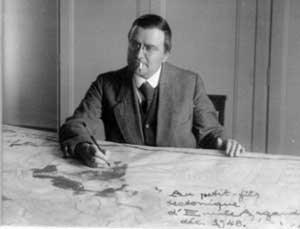
A photograph of Emile Argand drawing his famous map
of Asia, taken by Wegmann and inscribed by him: "Au petit-fils tectonique
d' Emile Argand, déc. 1948" (to the tectonic grandson of Emile Argand,
December 1948)
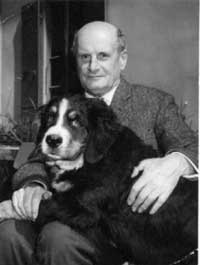
Professor Wegmann with his dog Ceppi, April 1966
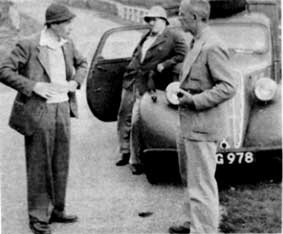
Donald MIntyre discussing the Moine Thrust with H.W.
Fairbairn at Oykell Bridge. Frank Turner, looking on, is leaning against
Donald's first vehicle, an ex-RAF van that had seen war-time use in North Africa.
Having his own car was unusual in 1951, but enabled him to get to the Highlands
to look at the localities at first hand.
|


